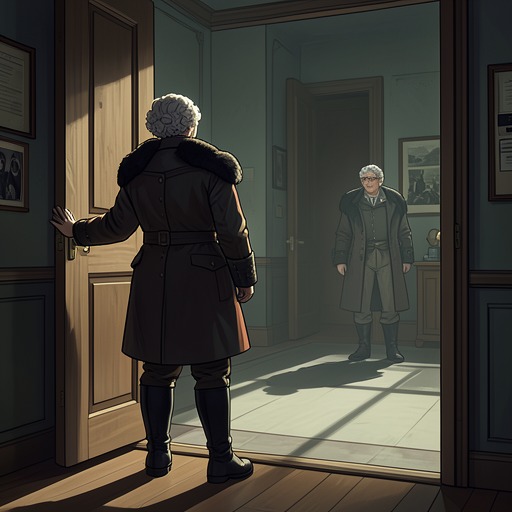
Miss Gannett
The Murder of Roger AckroydMiss Gannett is one of the village’s recurring social observers, a local gossip whose fragments of news help make King's Abbot’s close-knit information network visible. At the mah-jong table she passes on reports about Flora Ackroyd and Fernly Park, while her walk along the Cranchester road gives Hercule Poirot’s search for the missing Ralph Paton an accidental witness. Her role is not that of a formal investigator: she gathers and transmits what she hears, and the uncertain status of those reports is part of their significance.
Place in King's Abbot
Miss Gannett belongs to a village where gossip is described as the inhabitants’ defining recreation. The community has a large railway station, a small post office, and two rival general stores, but its social life is especially shaped by the people who stay: unmarried women and retired military officers. With only two houses considered important, King's Paddock and Fernly Park, news about the people connected to those properties travels through a compact local network.
That network is apparent at the mah-jong evenings hosted by Dr. James Sheppard and Caroline. Miss Gannett attends with Colonel Carter, and the game proceeds amid coffee, cake, sandwiches, tea, and conversation. The players’ gossip can interrupt the game, yet mah-jong is considered more peaceful than their former bridge because disputes over cards no longer create the same acrimony. The gathering gives Miss Gannett a social setting in which to exchange information, but it also makes the passage of news inseparable from ordinary village entertainment.
Reports about Flora Ackroyd
During one game, Miss Gannett begins to report that she saw Flora that morning, then corrects herself after mistakenly claiming a tile. Caroline asks where the sighting took place; Miss Gannett replies that Flora did not see her. The exchange turns a small act of observation into a suggestive disclosure. Caroline follows up by asking whether Flora was with anyone, and Miss Gannett answers that she was very much accompanied. The two women meet each other’s eyes, as if the implication has been communicated without being stated plainly.
The scene shows how Miss Gannett’s information works: it arrives as an observation, not a verified account of what Flora was doing or why. Her manner gives the report weight in the room, while its lack of detail leaves others to interpret it. The moment belongs to a wider pattern in which village talk converts glimpses and hints into shared knowledge, sometimes before anyone can establish what they mean.
The Fernly Park theft rumor
At another evening gathering, Miss Gannett carries a more elaborate report about money said to have been stolen at Fernly Park. She says her maid Clara is friendly with Elsie, the housemaid there, and attributes the accusation to Elsie’s opinion that the parlour maid may have been involved. Miss Gannett adds that the parlour maid is leaving at the end of the month and cries at night; from these details she speculates that the girl may be connected with a gang.
Miss Gannett also explains the grounds on which she has judged the servant suspicious. The girl is not friendly with the other local girls, goes out alone on her days off, and once refused Miss Gannett’s invitation to the Friendly Girls’ Evenings. When Miss Gannett questioned her about her family and background, the girl answered in a way Miss Gannett considered impertinent, though outwardly respectful. The report therefore combines hearsay from a chain of servants with Miss Gannett’s own moral interpretation of independence and reserve. The episode shows how the village’s information network can spread an accusation without turning it into established fact.
The murder and village speculation
The Ackroyd murder is another subject around which Miss Gannett’s social circle circulates theories. Colonel Carter tells Dr. Sheppard that he has heard blackmail mentioned and confidently predicts that a woman must be involved. His pronouncement is presented as private confidence between men of the world, but it is one more speculative contribution to the village’s public understanding of the case. Miss Gannett is present at the same kind of social gathering where such theories pass into conversation, while the villagers’ appetite for news forms the background to her own reports.
The contrast between the village’s certainty and the limited basis for its claims matters. A report may begin with an actual sighting or with a servant’s account, then acquire additional meaning as it is retold. Miss Gannett’s observations are useful evidence of what people have heard and noticed, but they do not by themselves prove the accusations or explanations that grow around them.
The Cranchester road and Poirot’s inquiry
Caroline argues that Ralph has not escaped by train and may still be in Cranchester, close enough that nobody would think to look for him there. Miss Gannett adds a detail from her own movements: she was walking on the Cranchester road that afternoon and saw Hercule Poirot pass in a car coming from that direction. The group looks at one another as the coincidence becomes apparent; Miss Gannett then realizes that she has been so absorbed in mah-jong that she failed to notice her own hand.
Her recollection does not itself disclose Ralph’s hiding place, but it places Poirot’s movements along the same road that features in Caroline’s theory. Later, Poirot explains how he reasoned that Dr. Sheppard would conceal Ralph somewhere nearby rather than at a hotel or in ordinary lodgings. He tested the possibility of a nursing home by inventing a nephew with mental troubles, consulted Caroline about suitable institutions near Cranchester, and learned that her brother had sent patients to two such homes. At one of them, a patient brought in by the doctor early Saturday morning was identified as Ralph, who had been admitted under another name. Miss Gannett’s sighting is thus part of the village’s incidental record of Poirot’s movements, while the solution depends on Poirot’s deliberate investigation and Caroline’s practical knowledge.
Narrative significance
Miss Gannett’s brief appearances help map the social machinery through which King's Abbot interprets the crime. News moves from household to household, from servants to employers, and across the mah-jong table; alongside it travel suspicion, personal judgments, and confident guesses. Her reports have different levels of reliability, from what she says she saw herself to what she repeats from Elsie through Clara, and her narrative function lies partly in making those distinctions visible.
She also gives the village’s gossip a comic, ordinary setting. A potentially consequential observation about Flora is delivered in the rhythm of a tile game; a report of suspected theft competes with talk about Poirot and the murder; and Miss Gannett’s attention to the game makes her overlook her own mah-jong hand. These turns keep the information network human rather than abstract: its participants are curious, distracted, and eager to interpret. Miss Gannett is therefore both a source of local detail and an example of the limits of local knowledge.